
Dehydrated Oily Skin in Air-Con Offices: Why Face Misting Makes It Worse & How 3% Ceramide 3:1:1 Lipid Therapy Fixes It

Dr. Evelyn Lim
Lead Formulator & Dermal Biochem Scientist at SYUEO Lab
1. The 2 PM Office Dilemma: Greasy T-Zone Meets Tight, Flaking Cheeks
If you work in an office tower in Singapore, Kuala Lumpur, or Hong Kong, you know the feeling all too well. Outside, the tropical air is 32°C to 34°C with 85% to 90% relative humidity. Inside, commercial chiller systems drop the room temperature to 18°C–20°C and drop ambient humidity down to 30%–40%. By mid-afternoon, your forehead and nose reflect bright fluorescent lights with oxidized sebum, yet your cheeks, smile lines, and under-eye area feel taut, irritated, and papery.
This condition is commonly termed 'dehydrated oily skin' (oily surface, parched interior). It is not a genetic skin type, but an acquired functional breakdown of the epidermal barrier. When chilled dry air constantly strips water from your outermost stratum corneum, the skin attempts to protect itself by pumping out more squalene and wax esters through the sebaceous glands. The result is a compounding disaster: slick grease floating over compromised, microscopically cracked keratin sheets.
2. The Evaporative Trap: Why Spraying Water Mists Accelerates Moisture Depletion
When office workers feel their skin tightening at 2:30 PM, the instinctive reaction is reaching for a desktop facial spray—frequently a can of French thermal spring water or plain mineral mist. You mist your face, feel a momentary refreshing chill, and return to typing. Within twenty minutes, your skin feels significantly tighter than before.
This is governed by the laws of thermodynamic vapor pressure. Liquid water droplets deposited on skin in a low-humidity environment cannot permeate the hydrophobic stratum corneum without lipid permeation enhancers. Instead, they evaporate into the dry office air. As each droplet evaporates, it absorbs latent heat of vaporization from your epidermal surface and draws out your skin's endogenous natural moisturizing factors (NMFs) through capillary suction. Repeatedly misting your face without sealing it with occlusive lipids literally dehydrates your skin faster than doing nothing at all.
3. Pure Water Mists vs. 3:1:1 Biomimetic Lipid Emulsions: What Actually Works
To stop the cycle of daytime dehydration and reactive oiliness, you must replace the missing mortar between your corneocyte cells, not flood the surface with unsealed moisture. Below is the physiological comparison between standard water sprays and bio-identical barrier lipids:
| Evaluation Parameter | Mineral / Thermal Water Mists | 3:1:1 Bio-Identical Ceramide Matrix |
|---|---|---|
| Carrier Formulation | 99.5%+ Free water with trace inorganic salts (Ca, Mg, HCO3) | Zero added water or physiological lipid emulsion with lamellar bilayer matrix |
| Intercellular Action | Sits loosely on skin surface; cannot intercalate into lipid bilayers | Intercalates directly into stratum corneum lamellar sheets between corneocyte bricks |
| TEWL Impact in Low Humidity (35% RH) | Increases TEWL by 18%–24% post-evaporation due to capillary water pull | Reduces TEWL by 42%–58% within 2 hours by reinforcing hydrophobic seal |
| Sebaceous Gland Response | Triggers rebound sebum secretion within 45–60 minutes to replace stripped surface coat | Calms hyperactive sebaceous signaling by sending feedback that barrier is intact |
| Pore Congestion Risk | Zero direct oil, but oxidized excess sebum clogs pores downstream | Non-comedogenic, biomimetic lipids absorb cleanly with zero pore occlusion |
| Clinical Indication | Immediate post-cleansing skin wetting before serums only | Morning defense shield and all-day barrier stability in air-conditioned environments |
4. Differentiating Daily Barrier Support vs. Emergency Rescue: 3% Serum vs. Ampoules
Human stratum corneum intercellular lipid mortar consists primarily of three components: ceramides (~50%), cholesterol (~25%), and free fatty acids (~15%). Clinical dermatology studies dating back to Man et al. and Elias et al. demonstrated that applying pure ceramide alone—without its physiological counterparts—delays barrier recovery. Only when ceramides, cholesterol, and fatty acids are formulated in an equimolar or 3:1:1 physiological ratio do they rapidly assemble into mature multi-lamellar lipid sheets.
Within the SYUEO formulation architecture, we engineer two distinct, complementary solutions depending on your skin's immediate clinical stage:
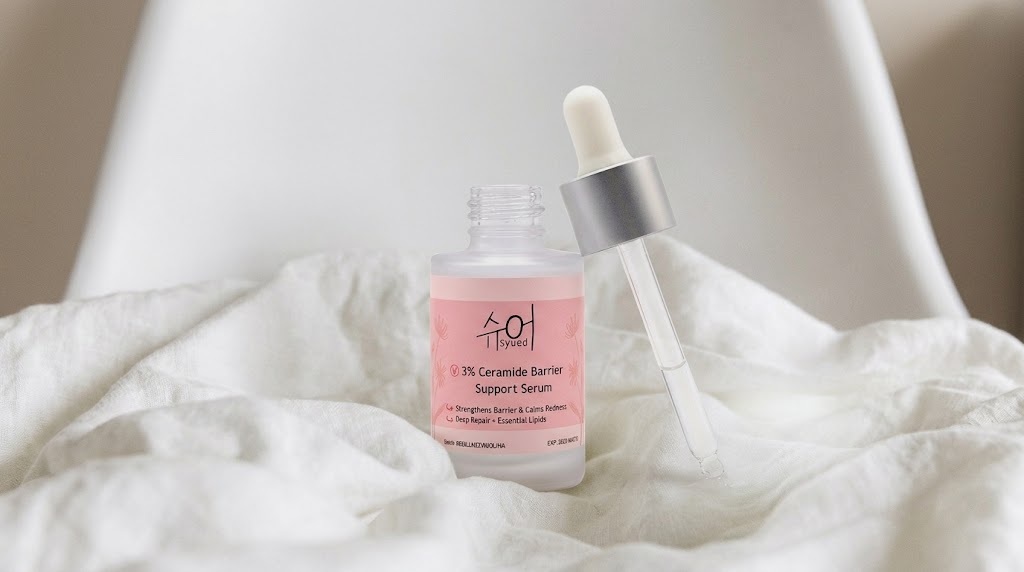
Daily Balance: 3% Ceramide Barrier Support Serum (30ml)
Designed for everyday morning-and-night barrier maintenance. Formulated with a potent 3% concentration of full-spectrum 5 ceramides (Ceramide NP, AS, NS/NG, AP, EOP) paired with physiological Cholesterol, Hydrogenated Lecithin, and Octyldodecanol. It rebuilds the natural 3:1:1 lamellar lipid bilayer, while pharmaceutical-grade Asiaticoside, Panthenol B5, and soymilk postbiotic filtrate fortify the skin's acidic microbiome defense without causing heaviness or clogged pores.
Emergency Rescue: Ceramide Ampoules Plus (3ml × 6)
Designed for acute flare-ups, severe peeling, and laser/retinoid micro-injuries. Features a high-potency triple ceramide complex (NP, AP, NS) combined with Phytosterols, Squalane, and Jojoba Seed Oil. It is uniquely enriched with Horse Chestnut Extract (Aesculus Hippocastanum) and Bisabolol to calm dilated facial microvessels and redness, alongside Glyceryl Glucoside to activate Aquaporin-3 (AQP3) cellular hydration channels.
5. The 3-Step Clinical Protocol: Managing Dehydrated Oily Skin from 9 AM to 6 PM
Rebalancing your skin in a high-AC environment requires an intelligent daily rhythm rather than aggressive midday washing or constant powder blotting. Here is the aesthetician-approved daily routine:
Step 1: Morning Defensive Barrier Shield
Cleanse with a non-stripping, low-foaming amino acid wash. On damp skin, apply 4–5 drops of 3% Ceramide Barrier Support Serum, pressing it gently into your cheeks and T-zone. Follow with a light lotion like Hyaluronic Acid Milk Moisturizer to seal the lipids before sunscreen.
Step 2: Midday 2 PM Reset Without Face Misting
Do not spray bare mineral water. If your T-zone is shiny, press a single-ply tissue or unbleached blotting paper onto the nose and forehead to lift oxidized oil without rubbing. Next, dispense half a pump of 3% Ceramide Serum or 1 drop of Ceramide Ampoules Plus onto your clean palms, rub them together, and press (never rub) onto your tight cheeks over makeup. It re-lubricates the lipid membrane without disturbing foundation.
Step 3: Evening Thermal Recovery Infusion
After work, wash off city grime and sunscreen. Twice weekly, apply a generous layer of Blue Copper Jelly Mask for 20 minutes. Its cooling hydrogel dissipates pent-up dermal heat, while GHK-Cu peptides signal fibroblasts to replenish extracellular hyaluronic acid.
6. Three Common Air-Conditioning Skin Habits to Stop Immediately
Eliminating these three habitual errors will protect your barrier from daily micro-tears:
Habit 1: Sitting Directly in the Chilled Airflow Path
Position your desk monitor or adjust air vent louvers so chilled drafts do not blow directly onto your face. Constant laminar air velocity dramatically accelerates surface evaporation rates regardless of what products you wear.
Habit 2: Midday Powder Caking Over Greasy Spots
Dabbing talc or silica powder onto oxidized sebum creates a paste that suffocates follicular openings. Always blot surface oil with a clean tissue first before lightly dusting powder.
Habit 3: Over-Exfoliating at Night to Remove Day Grease
Stripping your face with harsh scrubs or high-strength AHA toners every evening punishes your already compromised stratum corneum. Limit exfoliating acids to once or twice weekly, focusing nightly routines on lipid replenishment.
Frequently Asked Questions (FAQ)
Q.Why does my face feel so greasy if my skin is actually dehydrated?
Dehydration refers to water content in the stratum corneum (less than 10% water induces flaking and micro-tears), while oiliness refers to sebaceous gland lipid output. When your stratum corneum lacks moisture, it lacks structural flexibility. The sensory receptors trigger a stress response, signaling the sebaceous glands to produce excess sebum as an emergency waterproof varnish.
Q.What is the difference between 3% Ceramide Serum and Ceramide Ampoules Plus?
The 3% Ceramide Barrier Support Serum (30ml) is your daily restorative baseline, featuring a full-spectrum 5-ceramide complex (NP, AS, NS/NG, AP, EOP) with cholesterol and soymilk postbiotics for long-term lipid balance. In contrast, Ceramide Ampoules Plus (3ml × 6) is an acute clinical rescue treatment featuring triple ceramides, phytosterols, horse chestnut extract for vascular redness, and glyceryl glucoside to stimulate aquaporin-3 water channels during flare-ups.
Q.Will a ceramide serum cause acne or clog my oily T-zone?
No, provided the formulation is free of comedogenic heavy waxes. Bio-identical ceramides (NP, AP, EOP) are identical to the lipids your skin naturally produces. In fact, acne-prone skin consistently shows deficient levels of Ceramide NP and elevated linoleic acid depletion. Replenishing ceramides fluidizes sebum and prevents dead skin cells from compacting into blackheads.
Q.Can I use facial mist if I immediately apply a moisturizer on top?
Yes. The danger of facial mist lies solely in unsealed evaporation. If you mist and immediately seal it with a ceramide-rich serum or lightweight lotion like our 3% Ceramide Barrier Support Serum while skin is still damp, you effectively trap that hydration inside the stratum corneum.
Q.How many days of 3:1:1 ceramide treatment does it take to see results?
In clinical barrier-disruption trials, applying a physiological 3:1:1 lipid mixture produces measurable TEWL reduction within 2 to 4 hours. Visible reduction in midday oiliness and cheek tightness typically stabilizes within 5 to 7 days as the stratum corneum completes its natural repair cycle.
Featured Formulations Mentioned In This Article
3% Ceramide Barrier Support Serum
Full-Spectrum 5-Ceramide Matrix (NP, AS, NS/NG, AP, EOP) + Physiological Cholesterol + Asiaticoside + Soymilk Postbiotic | 30ml
Ceramide Ampoules Plus
Triple Ceramide Complex (NP, AP, NS) + Phytosterols + Horse Chestnut Microvascular Support + Aquaporin-3 Glyceryl Glucoside | 3ml × 6
Hyaluronic Acid Milk Moisturizer
Multi-Molecular Weight Hyaluronate + Hydrolyzed Jojoba Esters + Panthenol B5 Lightweight Barrier Lotion | 100ml
Blue Copper Jelly Mask
Copper Tripeptide-1 (GHK-Cu) + Portulaca Oleracea + Dipotassium Glycyrrhizate Cooling Gel | 300g
Related Clinical Guides In This Pillar
How a Damaged Skin Barrier Forms and How to Rebuild It: Stratum Corneum Lipid Science & Clinical Protocol
A damaged skin barrier forms when intercellular lipids (ceramides, cholesterol, and fatty acids) are stripped, spiking trans-epidermal water loss and neurogenic stinging.
Clogged Pores, Oxidized Blackheads, and Recurring Breakouts: From Sebaceous Hyperactivity to Dual-Phase BHA/PHA & Oligopeptide Resolution
Clogged pores and recurring acne form through a four-stage follicular cascade—5α-reductase sebum excess, squalene oxidation, hyperkeratinization, and C. acnes inflammation.
How Hyperpigmentation, Melasma, and Dark Spots Form: The 4-Stage Melanin Cascade & Clinical Brightening Protocol
A clinical dermatology guide to dark spots, vascular melasma, post-acne hyperpigmentation (PIH), and yellow glycation sallowness. Learn how melanin forms across 4 biological stages and how to fade stubborn pigment without compromising your skin barrier.
Clinical Disclaimer: The topical protocols, biological mechanisms, and formulation data published in this journal are developed by the SYUEO Formulation Laboratory for aesthetic education and professional guidance. Individuals with chronic dermatological conditions (e.g. severe rosacea, open cystic lesions, or active eczema) should consult a certified dermatologist before starting any intensive active protocol.
© 2026 SYUEO Apothecary & Botanical Skincare Lab. All rights reserved. Registered Entity: SYUEO MALAYSIA EMPIRE (SSM Registration: 003593452-M).