
Press It to Test: Why Your Acne Marks Won't Fade for Months (The Clinical Guide to Red PIE vs. Brown PIH)

Dr. Evelyn Lim
Lead Formulator & Dermal Biochem Scientist at SYUEO Lab
1. The 10-Second Blanching Test: Are Your Marks Vascular or Pigmentary?
Most individuals struggling with lingering spots after a breakout make the critical error of treating all dark spots identically. When a pimple subsides, the visible mark left behind stems from one of two fundamentally distinct biological mechanisms: Post-Inflammatory Erythema (PIE) or Post-Inflammatory Hyperpigmentation (PIH).
You can determine your mark type immediately using the clinical blanching test. Take a clean fingertip or a clear glass slide and press firmly against the center of the mark for three seconds. If the mark temporarily turns pale or skin-toned under pressure, and rapidly flushes red again once pressure is released, you have PIE. This redness is caused by dilated and damaged micro-capillaries pooled with blood in the papillary dermis. If the mark remains unchanged in color under pressure, showing a brown, tan, or purplish hue, you have PIH, which represents excess melanin granules deposited into keratinocytes or engulfed by dermal macrophages.
2. PIE vs. PIH Clinical Comparison Matrix: Pathology, Triggers, and Solutions
Understanding the structural divergence between vascular trauma and pigment synthesis dictates which active ingredients will heal the skin versus which will exacerbate it. The matrix below contrasts both conditions:
| Clinical Diagnostic Metric | Red Acne Marks (PIE / Vascular) | Brown & Black Marks (PIH / Pigmentary) |
|---|---|---|
| Biological Mechanism | Dermal capillary dilation, micro-vessel fragility, and sustained inflammatory cytokine signaling (VEGF, TNF-alpha) | Hyperactive melanocyte response triggered by inflammatory prostaglandins (PGE2, leukotrienes), transferring melanosomes upward |
| Pressure Test Reaction | Blanches (turns pale white) immediately, refills with pink-red blood upon release | Zero blanching reaction; pigment remains fixed and dark under direct mechanical compression |
| Primary Depth in Skin | Upper papillary dermis microvascular plexus (beneath basal membrane) | Epidermal basal layer, with deeper cases migrating into dermal melanophages |
| Natural Clearance Duration | 6 to 18 months in warm, humid climates due to heat-induced microvascular flushing | 12 to 24 months, with ultraviolet UV radiation drastically extending dark retention |
| Fatal Skincare Mistake | Slathering high-concentration AHA/BHA chemical peels, causing acid burns that stimulate melanin and turn red marks into dark marks | Using abrasive physical scrubs, which induce mechanical micro-wounds and restart the inflammatory hyperpigmentation cycle |
| Evidence-Backed Actives | Oligopeptide-1, Tripeptide-1 Copper, Centella Asiatica, Horse Chestnut (Aescin), Ceramides | Tranexamic Acid, Alpha-Arbutin, Niacinamide, Nonapeptide-1, Ethyl Ascorbic Acid |
3. Why Aggressive Chemical Peels Make Red Acne Marks Worse
A widespread myth across skincare forums suggests applying 10% glycolic acid or 2% salicylic acid daily over fresh post-acne marks to peel them away. While salicylic acid is effective for clearing sebum in active comedones, applying strong exfoliants over a red mark is counterproductive.
A fresh red mark is essentially a healing micro-wound with an incomplete, fragile stratum corneum. Applying harsh keratolytic acids strips intercellular lipids, degrades the fragile basal membrane, and triggers an angiogenic surge of vascular endothelial growth factor (VEGF). This chemical irritation causes damaged capillaries to dilate further, transforming temporary erythema into chronic broken capillaries while provoking melanocytes to deposit dense dark melanin.
4. The Two-Phase Targeted Protocol: From Wound Repair to Melanin Clearance
Licensed aesthetic clinics approach post-acne recovery through two chronological, bio-compatible phases:
Phase 1 (Days 0 to 14): Vascular Calming & Rapid Re-Epithelialization
For fresh pink and red marks, prioritize healing over exfoliation. Apply Oligopeptide Ampoules Plus twice daily. Its bio-engineered growth factor peptides (Oligopeptide-1, 2, 3) stimulate keratinocyte migration and accelerate wound closure, while horse chestnut extract strengthens capillary wall integrity to stop vascular pooling. Layer with Ceramide Ampoules Plus to seal moisture without clogging pores.
Phase 2 (Days 14 to 45): Pigment Interception & Melanosome Clearance
Once the surface barrier is fully intact, target remaining brown or grayish marks. Apply Tranexamic Acid Ampoules Plus directly to dark zones. Tranexamic acid inhibits plasmin activation, blocking the arachidonic acid cascade that converts lingering erythema into melanin. Follow with 5% Niacinamide 4% Arbutin Nonapeptide-1 Serum to intercept melanosome transfer into surrounding epidermal cells.
5. Daily Step-by-Step Routine Framework for Acne-Prone Skin in Humid Climates
Follow this structured regimen to clear active breakouts and prevent future mark formation in tropical conditions:
Morning Routine: Vascular Defense & Photoprotection
Cleanse with a low-foaming amino acid cleanser. Tap Oligopeptide Ampoules Plus onto healing red areas. Smooth a few drops of 5% Niacinamide 4% Arbutin Nonapeptide-1 Serum across zones prone to dark spots. Complete with a photostable fluid sunscreen, such as Broad-Spectrum Multi-Defense Sunscreen Milk SPF50+ PA++++, to prevent UV radiation from setting vascular marks into permanent dark spots.
Evening Routine: Targeted Treatment & Barrier Repair
Cleanse thoroughly to remove sebum and sunscreen. If active cystic bumps are developing, apply a targeted SOS Acne Fighter Patch (Micro Needle) to deliver active peptides and madecassoside directly into the core, eliminating the need to squeeze. On established dark marks, smooth Tranexamic Acid Ampoules Plus. Seal the skin with a lightweight ceramide moisturizer.
Frequently Asked Questions (FAQ)
Q.Can an untreated red acne mark (PIE) turn into a dark brown mark (PIH)?
Yes. In warm, sunny regions, unshielded ultraviolet radiation and persistent heat stimulate local melanocytes adjacent to dilated micro-capillaries. If a fresh red mark is exposed to sun, picked at, or scrubbed with harsh exfoliants, the inflammatory reaction stimulates melanin synthesis, converting vascular PIE into deep pigmentary PIH.
Q.Why do my red acne marks look significantly redder after a hot shower or workout?
This flushing is characteristic of vascular erythema. Physical exertion, elevated ambient temperature, and hot water cause cutaneous blood vessels to dilate rapidly. Because the micro-capillaries beneath a post-acne mark are compromised and lack normal vasomotor tone, blood pools there quickly, making marks appear intensely red temporarily.
Q.Should I squeeze a pimple or use a microneedle patch to minimize post-acne marks?
Never manually squeeze or pop pimples. Squeezing ruptures delicate follicle walls beneath the surface, driving bacteria deeper and tearing dermal micro-capillaries, which guarantees severe PIE and textural pitting. Applying a dissolvable micro-dart patch like SOS Acne Fighter Patch (Micro Needle) flattens swollen bumps cleanly while keeping the barrier sealed.
Q.Can I use tranexamic acid on fresh red acne marks, or is it only for brown spots?
Tranexamic acid is beneficial for both stages. Beyond its pigment-inhibiting properties, tranexamic acid acts as a plasmin inhibitor that dampens inflammatory vascular signaling. Using Tranexamic Acid Ampoules Plus during the late red mark stage prevents the inflammatory cascade from transitioning into dark melanin deposits.
Q.How long does it realistically take to fade red versus brown acne marks?
With a dedicated growth-factor and barrier routine, fresh vascular red marks (PIE) typically improve noticeably within 2 to 4 weeks as capillaries stabilize. Brown pigmentary marks (PIH) align with the natural 28-day epidermal renewal cycle, generally fading substantially within 4 to 8 weeks when treated with tranexamic acid and niacinamide.
Featured Formulations Mentioned In This Article
Oligopeptide Ampoules Plus
Triple Growth-Factor Peptides (Oligopeptide-1, 2, 3) + Carboxymethyl Chitosan + Kuh-Seng & Andrographis + Horse Chestnut | 3ml × 6
Tranexamic Acid Ampoules Plus
Tranexamic Acid + Nonapeptide-1 + Niacinamide + 3-O-Ethyl Ascorbic Acid + Rice Ferment + Glutathione & Resveratrol | 3ml × 6
5% Niacinamide 4% Arbutin Nonapeptide-1 Serum
Nonapeptide-1 (MC1-R Blocker) + 4% Arbutin + 5% Niacinamide + Carnosine & Albizia Anti-Glycation + 3D Aquaxyl | 30ml
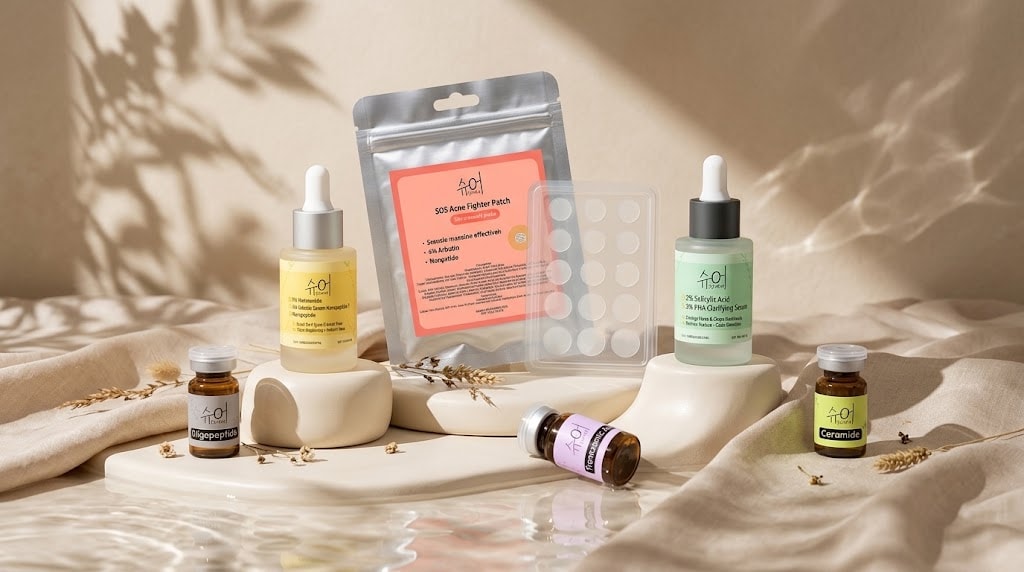
SOS Acne Fighter Patch (Micro Needle)
Self-Dissolving Hyaluronic & Trehalose Micro-Darts + Madecassoside + GHK-Cu + 3-Peptides + Niacinamide + Ceramide NP | 6 Patches
2% Salicylic Acid 3% PHA Clarifying Serum
2% Salicylic Acid (BHA) + 3% Gluconolactone (PHA) + Quaternium-73 & O-Cymen-5-ol + Pear Ferment & Houttuynia | 30ml
Ceramide Ampoules Plus
Triple Ceramide (NP, AP, NS) + Phytosterols + Horse Chestnut Extract + Glyceryl Glucoside (AQP3) + Squalane | 3ml × 6
Related Clinical Guides In This Pillar
Clogged Pores, Oxidized Blackheads, and Recurring Breakouts: From Sebaceous Hyperactivity to Dual-Phase BHA/PHA & Oligopeptide Resolution
Clogged pores and recurring acne form through a four-stage follicular cascade—5α-reductase sebum excess, squalene oxidation, hyperkeratinization, and C. acnes inflammation.
Best Acne Patches 2026: Hydrocolloid vs Microneedle Patches for Deep Blind, Cystic Pimples
A clinical guide comparing traditional hydrocolloid stickers with self-dissolving microneedle acne patches. Learn how 250μm hyaluronic micro-darts penetrate deep cystic bumps, deposit anti-inflammatory peptides directly into follicular lesions, and prevent long-term pitting scars.
How a Damaged Skin Barrier Forms and How to Rebuild It: Stratum Corneum Lipid Science & Clinical Protocol
A damaged skin barrier forms when intercellular lipids (ceramides, cholesterol, and fatty acids) are stripped, spiking trans-epidermal water loss and neurogenic stinging.
Clinical Disclaimer: The topical protocols, biological mechanisms, and formulation data published in this journal are developed by the SYUEO Formulation Laboratory for aesthetic education and professional guidance. Individuals with chronic dermatological conditions (e.g. severe rosacea, open cystic lesions, or active eczema) should consult a certified dermatologist before starting any intensive active protocol.
© 2026 SYUEO Apothecary & Botanical Skincare Lab. All rights reserved. Registered Entity: SYUEO MALAYSIA EMPIRE (SSM Registration: 003593452-M).